When Will Air Taxis Actually Launch in India? Reality vs Hype
What if your 90-minute traffic commute becomes 7 minutes?
That’s the promise driving the global race toward air taxis. And in India, where urban congestion isn’t just frustrating but economically damaging the idea feels almost inevitable.
But here’s the uncomfortable truth: air taxis are closer than you think but not for the reason you expect.
Most people assume the aircraft is the hard part. It isn’t.
The real bottleneck sits firmly on the ground.
The Core Reality: Air Taxis Will Be Delayed by Infrastructure, Not Aircraft
The global conversation around air taxi launch in India often focuses on sleek electric aircraft, futuristic renders, and bold timelines—2026, 2027, “just a few years away.”
But after two decades tracking aviation transitions, one pattern is clear:
Aviation doesn’t scale when technology is ready. It scales when systems are ready.
India is no exception.
While eVTOL aircraft technology, electric vertical takeoff and landing vehicles, is advancing rapidly, the ecosystem required to support them is still in its infancy.
And that ecosystem is everything.
The Aircraft Are (Almost) Ready
Globally, companies like Joby Aviation, Archer Aviation, and Volocopter have already flown full-scale prototypes.
Some are approaching certification.
In India, players like InterGlobe Enterprises (partnering with Archer) and Tata Group are exploring the space seriously.
Technologically, the aircraft check many boxes:
- Electric propulsion (lower emissions, lower noise)
- Autonomous-ready systems (though pilots will initially be required)
- Vertical takeoff (no runway dependency)
So yes, flying taxis in India are technically feasible within this decade.
But that doesn’t mean they’ll launch at scale.
The Invisible Barrier: Vertiports
Here’s the part most headlines ignore.
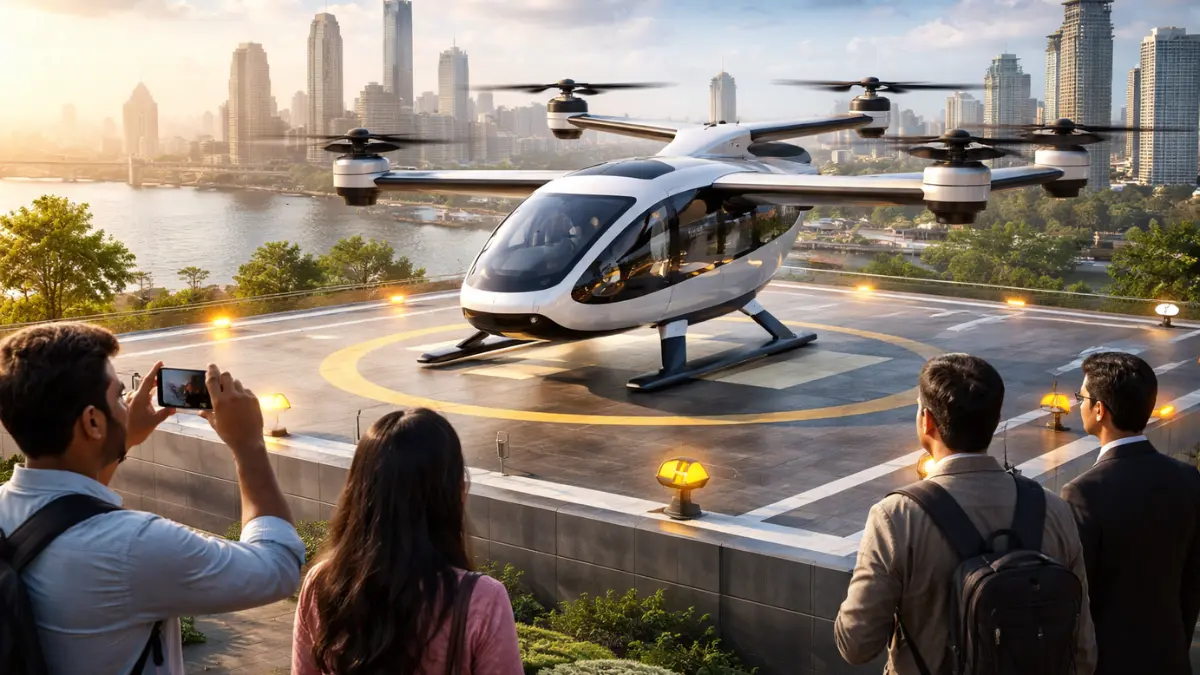
Air taxis don’t operate like helicopters. They require a network, a distributed system of takeoff and landing points known as vertiports.
Think of them as:
- Mini airports on rooftops
- Integrated mobility hubs
- Digitally managed traffic nodes
India currently has zero operational vertiport networks.
And building them isn’t just construction—it’s coordination across:
- Urban planning authorities
- Real estate developers
- energy infrastructure providers
- digital air traffic systems
The real revolution isn’t the aircraft, it’s the network.
Without vertiports, air taxis remain demonstration projects.
Regulation: The Silent Gatekeeper
Even if infrastructure appears, nothing flies commercially without regulatory approval.
In India, that responsibility lies with the Directorate General of Civil Aviation (DGCA).
And aviation certification is slow—for good reason.
Safety standards must address:
- Battery reliability in extreme climates
- Mid-air traffic management in dense cities
- Emergency landing protocols
- Pilot training for new aircraft categories
Globally, certification delays are already pushing timelines back.
India will likely follow a “wait-and-adapt” model, observing US and European approvals before accelerating its own.
Which means:
👉 A realistic air taxis India launch date is late decade not mid-decade hype.
The Timeline: Reality vs Hype
Let’s cut through the noise.
Hype says: 2026
Reality suggests: 2027–2030 (limited rollout)
Here’s a more grounded breakdown:
2025–2026
- Pilot projects
- Demonstration flights
- Early partnerships
2027–2028
- Initial commercial routes (airport-to-city, premium corridors)
- Limited fleet operations
2029–2030
- Network expansion
- Early signs of scalability
This is not delay. This is normal aviation evolution.
Will Air Taxis Be Affordable?
Short answer: not at first.
Early electric air taxi India services will target:
- Business travelers
- High-income commuters
- Time-sensitive users
Think pricing similar to:
- Premium ride-hailing (5–10x surge pricing)
- Helicopter-lite services
But here’s where it gets interesting.
As fleets scale and battery costs drop:
- Per-seat pricing could approach business-class train fares
- Shared aerial rides become viable
- Urban air transport systems become semi-accessible
Air taxis won’t start as mass transport but they could evolve into it.
Safety: The Biggest Public Question
Every new aviation system faces skepticism.
“Is this safe?”
“Will batteries fail mid-air?”
“What about crowded airspace?”
These are valid concerns.
But consider this:
Modern eVTOL aircraft are being designed with:
- Multiple redundant motors
- Fail-safe landing systems
- Real-time diagnostics
- AI-assisted flight control
In many cases, they could be safer than helicopters.
Still, public trust won’t come from engineering it will come from time and track record.
India vs Global Progress
Globally, air mobility is already moving from concept to reality.
- United States: Certification nearing completion
- United Arab Emirates: Dubai planning early commercial routes
- France: Paris Olympics experiments accelerated development
India, meanwhile, has unique advantages:
- Massive urban demand
- Severe congestion (clear use case)
- Strong digital infrastructure
But also unique challenges:
- Complex urban layouts
- Regulatory caution
- Infrastructure gaps
Which creates a paradox:
👉 India needs air taxis more than most countries but may adopt them slower.
The Business Model Most People Miss
Air taxis aren’t just about transport.
They’re about time economics.
Imagine:
- A CEO cutting 2 hours of daily commute
- A doctor reaching emergency cases across cities
- A logistics company delivering high-value cargo instantly
This is where real value lies.
The first killer use case may not be passengers, it may be time-critical services.
A Glimpse Into the Future
Picture this.
It’s 2029.
You leave your home in Gurgaon.
A short ride takes you to a rooftop vertiport.
Within minutes, you’re airborne, quietly gliding over traffic.
Seven minutes later, you land near your office in central Delhi.
No gridlock. No stress.
Just time reclaimed.
That future is not science fiction.
But it won’t arrive overnight.
So, When Will Air Taxis Actually Launch in India?
Here’s the honest answer:
- Yes, air taxis in India are coming.
- No, they won’t arrive as fast as headlines suggest.
The delay isn’t technological.
It’s systemic.
Infrastructure, regulation, and network effects will decide everything.
Final Insight
Most people are watching the sky, waiting for futuristic aircraft to appear.
They’re looking in the wrong place.
The future of air taxis will be decided on the ground.
And when that ground network finally connects—
Air taxis won’t just change how we travel.
They’ll change how cities are designed.