
Your cart (14)
Please install WooCommerce

Last Updated:
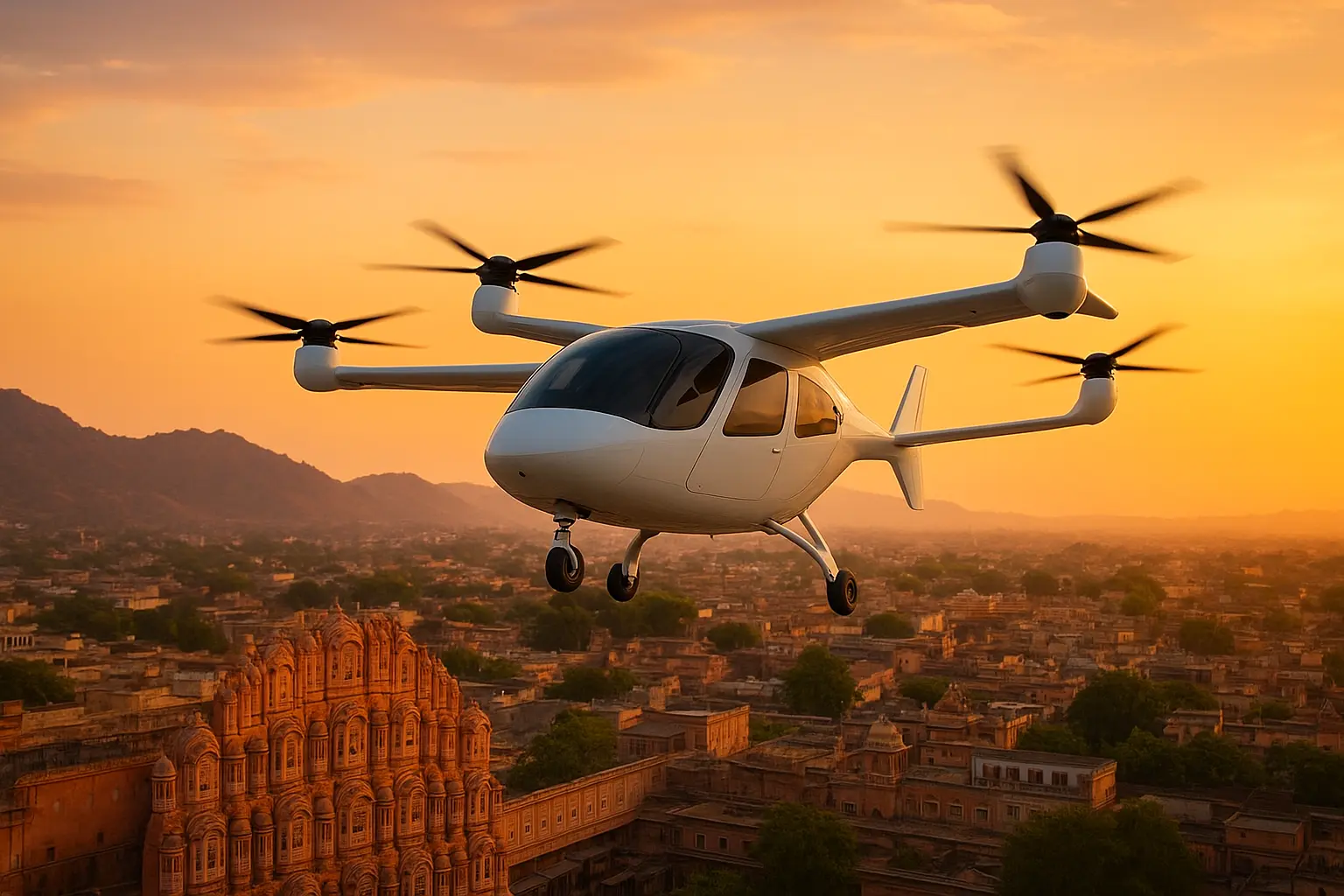
A New Dawn for Jaipur
Imagine stepping out of your home in Jaipur, sunlight shimmering off the pink sandstone walls, and boarding an air-taxi that lifts you into the sky. Twenty minutes later you are touching down in Udaipur, valley views beneath you, traffic jams and dusty roads farbehind. The hum of the rotor fades, replaced by the open skies. For a moment, you feel the thrill of possibility — of India’s future not bound to tarmac, but to the air above.
That vision is not just science fiction. As cities like Jaipur balloon in population and roads choke from vehicles, pollution, delays and infrastructure gaps weigh on daily life. Now, a new aviation solution is emerging: the electric vertical take-off and landing craft (eVTOL) and the broader concept of urban air mobility (UAM). Through the lens of MyOnlineJet, this article explores how Jaipur could become India’s first eVTOL-ready city by 2028 — and why that matters not just for Rajasthan, but for the heart of India’s mobility revolution.
“eVTOL” stands for electric Vertical Take-Off and Landing aircraft. In plain terms: an aircraft powered by electricity (either batteries, hybrid or other propulsion) which can take off and land vertically — much like a helicopter — and fly like a small airplane. For urban and regional use, they promise shorter flights, quieter operations, lower emissions.
📌 Vertiport is the concept of a landing/take-off pad, terminal and charging hub for such air-vehicles — the air-taxi equivalent of a bus-stop or metro station. The regulator in India has issued guidance for vertiport design.
UAM stands for Urban Air Mobility — transport of passengers or cargo via aircraft (including eVTOLs) within urban or suburban regions, or even connecting tier-2/3 towns and hinterlands, complementing road and rail. The goal: reduce travel time, reduce congestion, improve access.
India is moving fast: the Directorate General of Civil Aviation (DGCA) is developing regulatory frameworks, guidance for type-certification of vertical-takeoff aircraft, and vertiport infrastructure.
MyOnlineJet’s mission (hypothetical for this article) is to build a locally-rooted air-mobility ecosystem for Rajasthan and neighbouring states — developing prototypes, managing vertiport networks, and enabling Jaipur’s evolution into an eVTOL-ready city by 2028.
Tech Insight:
Adopting eVTOL & UAM offers numerous practical benefits — especially in Indian tier-2 & tier-3 cities like Jaipur region. Here are six key ones:
Here’s what the regulators and industry are saying — and how it aligns with the Jaipur / MyOnlineJet vision.
“In terms of regulatory preparedness for eVTOL services for urban air mobility, India will be ahead of the curve,” said an insider in June 2024 as the DGCA set up multiple panels.
For MyOnlineJet’s engineers and R&D team:
“We are building our prototype with Indian terrain and city-density in mind — Jaipur’s heritage zones, hot summers, dusty environment and high tourist flows make it an ideal early adoption ground for UAM.”
Let’s walk through how MyOnlineJet (MOJ) plans to make it real — from concept to cockpit.
This visual narrative — from app booking to smooth urban air hop — is how Jaipur transforms into an eVTOL-ready city.
Innovation must walk hand-in-hand with responsibility. Here’s what India’s regulatory environment looks like — and how MOJ is aligned.
MOJ’s philosophy: “Build it safe. Build it Indian. Build it inclusive.”
Meet Asha, a young entrepreneur in Jaipur. It’s September 2028, and she has a business meeting in Kota (230 km away by road, typically 4-5 hours, heavy traffic). She opens the MyOnlineJet app on her phone, selects the “Jaipur → Kota” eVTOL flight at 10:30 am.
She reaches the Vertiport at Jaipur’s outskirts by 10:05 am, checks in, is greeted by an MOJ staff member, completes a quick safety-briefing, and boards a sleek 6-seater electric air-taxi. At 10:30 am the rotors whirl, the craft lifts vertically, and the urban sprawl falls away beneath her. Quiet, smooth, panoramic views of Aravalli hills. At 11:00 am she lands at Kota’s vertiport. A local cab is ready to whisk her 5 minutes to her meeting. She arrives two hours early, refreshed, not drained by the road.
Along the way she notices the vertiport lounge — families boarding sightseeing hops to Udaipur, small cargo kits being swapped in, a battery-swap station humming quietly. She smiles, thinking: “This isn’t just flying — it’s freedom, it’s time saved, it’s India moving ahead.”
For Asha, and for millions in Rajasthan, this horizon is not distant — it’s within reach. Jaipur isn’t just the Pink City. It is the Sky City of India’s next mobility chapter.
Pros:
Cons/Challenges:
Differentiator for MOJ: Innovation with Indian roots — local manufacturing, city-specific design, regional connectivity rather than just major cities.
Q1: What is eVTOL technology in India?
A: eVTOL refers to electric Vertical Take-Off and Landing aircraft. In India, the DGCA has issued guidelines for type certification of eVTOLs (also called VCA: Vertical-take-off Capable Aircraft) and for vertiport infrastructure.
Q2: When will MyOnlineJet launch operations in Jaipur?
A: While a specific date depends on regulatory, infrastructure, and market readiness, this article’s premise envisions a fully operational Jaipur-based eVTOL ecosystem by 2028.
Q3: What are vertiports and how do they work?
A: Vertiports are landing/take-off hubs for eVTOLs: they include landing pads, passenger boarding lounges, charging or battery-swap infrastructure, maintenance bays. The DGCA in India has published guidance on design and operation of vertiports.
Q4: Is air taxi travel safe and regulated by DGCA?
A: Yes. The DGCA is actively working on regulatory frameworks for eVTOL operations, including certification, training, air-traffic integration, safety standards, and vertiport authorisation.
Q5: How will eVTOLs affect India’s environment and jobs?
A: Environmentally, eVTOLs can reduce ground traffic, lower emissions, and reduce congestion. From a jobs-perspective, there will be demand for manufacturing, maintenance, vertiport operations, air-traffic management, pilot/crew training — enabling skill-development and new employment in aviation and mobility ecosystems.
Q6: Will eVTOLs only be for rich users?
A: Initially, pricing may be a premium until scale-up. But as infrastructure and fleet scale increase, unit costs are expected to reduce. The goal of UAM is broader accessibility, not just luxury transport.
Q7: Can eVTOLs operate in India’s weather and terrain (monsoon, dust, high heat)?
A: Yes—with adaptation. Aircraft and infrastructure need to be designed for Indian conditions (heat, dust, winds). Local R&D (like MyOnlineJet’s) must account for these. Regulation and testing will require certified performance in such conditions.
Q8: Why Jaipur, and not only big cities like Delhi or Mumbai?
A: Because tier-2/3 cities like Jaipur offer a unique opportunity: less congested airspace, regional connectivity potential, heritage-tourism linkages, and government willingness to embrace innovation. Starting in Jaipur allows MyOnlineJet to build a scalable model before expanding to mega-metros.
From the pink sandstone of Jaipur to the blue horizon above the Aravalli hills, the vision of a new mobility era is within reach. By 2028, Jaipur could very well light up as India’s first eVTOL-ready city — where air-taxi flights, regional hops, lean vertiports and clean propulsion redefine how we commute, connect and dream.
We’ve covered why this matters: reduced travel-time, cleaner air, regional uplift, tourism growth, AI-driven safety, domestic manufacturing. We’ve examined the regulatory backbone: DGCA’s evolving frameworks, global standards, local compliance. We’ve walked through the prototype vision of MyOnlineJet: fleet, vertiports, AI, user experience, local focus. We’ve also seen the human story of Asha, living the future in 2028.
India’s sky is ready for a new chapter. Jaipur might just be the runway. Now it’s a matter of action, investment, collaboration — and ambition.
Follow MyOnlineJet as we redefine air mobility — one vertiport at a time. Let’s lift the future together.
Follow us on LinkedIn: https://linkedin.com/company/myonlinejet

About
Leave a Reply